Source: Camboja
Around 3,000 temporary houses would be constructed in three provinces to accommodate the remaining displaced families before the rainy season as existing displacement centers continue to endure extreme heat and requests for essential infrastructure at new sites.
Soth Kim Kolmony, a spokesperson for Cambodia’s National Committee for Disaster Management (NCDM), told CamboJA News that three provinces were identified for the construction, which is part of the government’s plan to provide temporary housing. They include 2,000 in Banteay Meanchey, 600 in Preah Vihear, and 200 in Oddar Meanchey.
In late January—a month after the ceasefire took effect on December 27—the National Committee for Disaster Management (NCDM) and Land Management Ministry announced plans to identify sites for temporary housing. The move aimed to ensure the safety of communities in five conflict-affected provinces, with thousands of displaced families in Banteay Meanchey among the primary beneficiaries.
As of February 16, 2026, around 75,500 people remain in shelters, unable to return home, according to the Ministry of Interior.
Since the ceasefire ended a second round of fighting in 2025, a large number of over half a million Cambodians who fled had returned home. The weeks-long clashes left more than 100 people dead and displaced nearly one million people on both sides of the border.
Oddar Meanchey is the second province after Banteay Meanchey where construction started on Monday, according to the NCDM. Construction in Banteay Meanchey began on Saturday, Kun Kim, First Vice President of NCDM, told local media.
The shelters are being built on 400 hectares of land donated by Ke Kim Yan, a member of the National Assembly for Banteay Meanchey constituency. Kim said each shelter measures 20 meters by 30 meters.
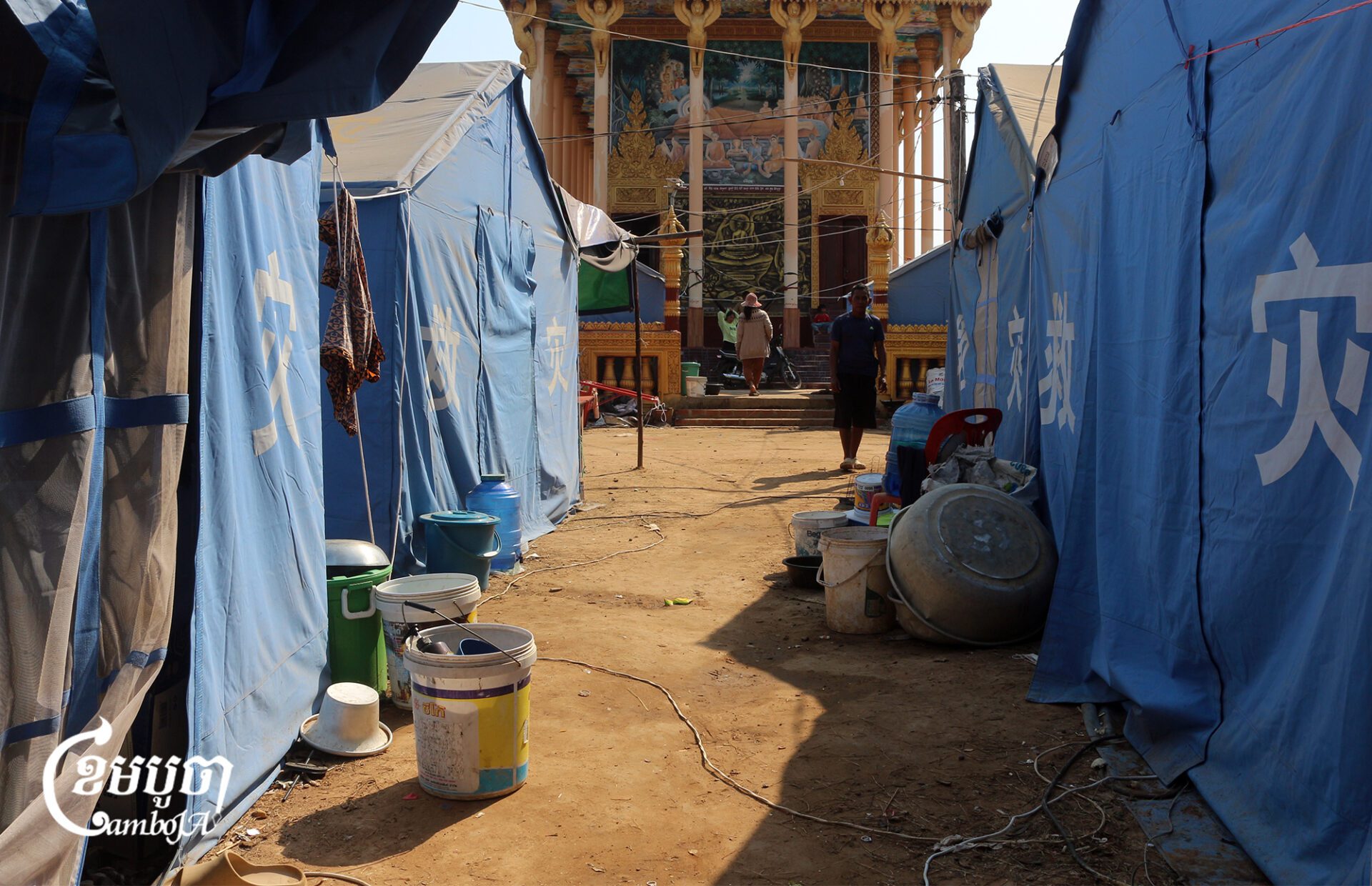
“It is so hot here [the pagoda camp in Banteay Meanchey], I cannot stay in a tent,” said Soeung Savy, a resident of Chouk Chey village near the canal that the Thai army dug after the ceasefire. “If we can move to the new shelter, I hope there will be free access to electricity. I will be happy [about it] because I do not have money,” he added, noting that water, electricity, and toilets are essential.
Banteay Meanchey deputy governor Ly Sovannarith told CamboJA News that temporary shelters are being built in Slakram commune, Svay Chek district, acknowledging the extremely hot conditions at the pagoda. However, he said, provincial authorities have arranged sufficient water for residents.
Before the remaining families move to the new site, the government would ensure that all infrastructure, including roads, water, and electricity, are ready.
Another resident, Koum Oeurb, from Chouk Chey village, said news about the temporary homes brought mixed feelings. While he is glad to get a temporary house, he is concerned about the distance to his children’s schools, as he has no means of transportation. He also hopes for job opportunities, as he currently lacks capital to start a business.
Kim said the temporary shelters will be completed before the rainy season. Once the border issue is resolved and families can return home, the houses will be handed back to the government, which plans to provide them to veterans and low-income families in the area later.
In addition to the shelters, he said the government will provide equity cards or IDPoor cards, free healthcare, and monthly social protection cash. At the same time, Kim said the Ministry of Agriculture would also request 50 to 70 hectares of land for crop cultivation, which would serve as a food source and income opportunity for displaced people.
Preah Vihear provincial spokesperson Kim Chanpanha told CamboJA News that the provincial administration has a master plan to build temporary houses for displaced people in Preah Vihear province at Kulen district. He added that there are around 2,000 families.
Moeun Tola, executive director of the Center for Alliance of Labor and Human Rights (Central), told CamboJA News that building temporary shelters is a good solution, particularly to address the complaints from displaced people about the extreme heat and lack of proper toilets.
However, he said information about the shelters should be better communicated to displaced families. Without clear details on the timeline or how to access the new housing, many are hesitant to seek work, and rely entirely on humanitarian aid.
“Due to uncertainty, some displaced people are afraid to take jobs far from the camps because they worry that they may not be included on the list when the temporary houses are ready or may not be able to take leave from work when relocation happens,” he said.
He also emphasized the need for land for farming and additional job opportunities to support displaced families in the long term.