Workers at two Thai-owned factories that remain operational have expressed fear of further layoffs as the companies continue to cut overtime and reduce working hours due to border issues, putting financial pressure on as trade between Cambodia and Thailand continues to decline.
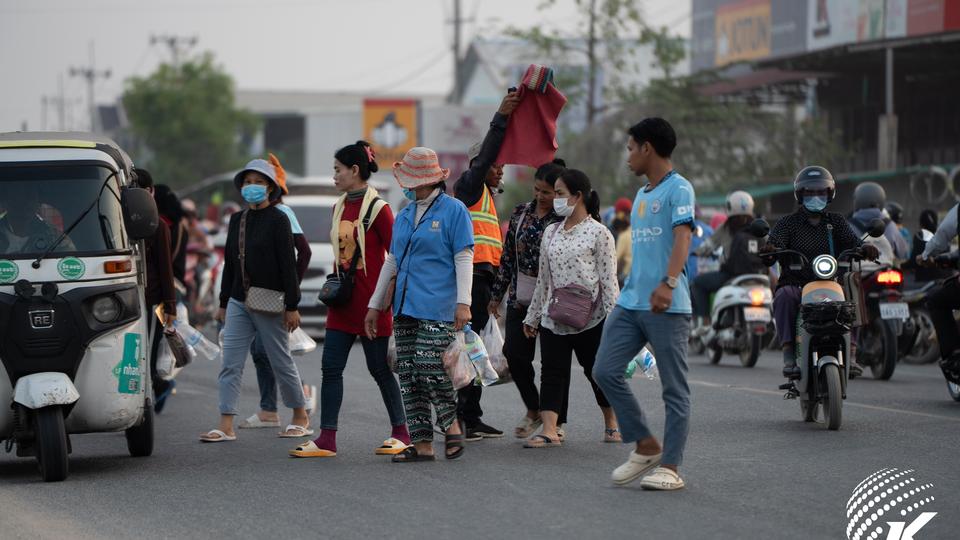
A series of factory closures has affected more than 4,000 workers in the Poipet O’Neang Special Economic Zone (SEZ) in Banteay Meanchey province, along the once-busy Cambodia-Thailand border crossing. The factories were forced to close amid border disruptions and sharply increased transportation costs.
Similar operational difficulties are affecting Thai-owned factories that remain open along the border, raising concerns among workers about job security, reduced working hours and future employment conditions.
Mao Yi Nhy, a production worker at T.K. Garment Sisophon, told Kiripost that she is concerned about irregular working hours and reduced income. Workers currently work only four to five days a week and receive about 50 percent of their regular salary, she said.
Since the 2025 border conflict, the company has laid off more than 200 workers.
"The company’s human resources told workers there was not enough work and that some workers would be terminated; keeping three people in a group," she said. New workers received termination notices two weeks before their scheduled termination and old workers two months.
“My cousin has worked for 11 years. They terminated her after informing her two months earlier," she said.
T.K. Garment Sisophon has operated in Cambodia for approximately 13 years since 2012. It employed more than 2,000 workers and produced casual fabrics and fashion dresses for more than 160 brands, including Reebok and Tom and Jerry.
The company told workers that the economic situation was worsening due to the border conflict, which made it difficult to import products, while costs of using air transport to export have increased, according to Yi Nhy.
Border disruption cuts overtime, raising uncertainty
Bun Thu, 40, a worker at KKN Apparel Co Ltd in Koh Kong, which supplies sportswear for global brands, including Nike and Adidas, said the closure of the Cham Yeam border checkpoint between Koh Kong and Thailand’s Trat province had disrupted their import and export routes.
He too said workers were informed of the challenging economic conditions.
“The company said they have spent twice for transportation. They have to plan detours through other parts of the country to reach Preah Sihanouk and Phnom Penh ports,” he recalled from a company management meeting in June 2026.
Thu said workers regularly relied on overtime to supplement their income, but overtime was dropped between May and June as border tensions intensified.
Some workers have also resigned because they are worried about the uncertainty surrounding the border situation, he said. The company told workers that although orders were regular, the border situation was causing difficulties.
“After the border clashes erupted, the company reported lower profit causing delays in salary payments,” he said.
Thai-owned KKN Apparel Co Ltd in Koh Kong Special Economic Zone was set up in 2012, employing around 2,500 workers.
Kiripost contacted T.K. Garment Sisophon and KKN Apparel Co Ltd for comment but they did not respond at the time of publication.
Workers fear being next in line for layoffs
T.K. Garment Sisophon in Banteay Meanchey and KKN Apparel Co Ltd in Koh Kong are in operation, but it has reduced working hours, resulting in irregular job schedules as well as the risk of further layoffs.
“I’m worried they [the company] would fire me after my cousin was terminated,” Nhy said, adding that is looking for another job.
Thu said many workers at the factory have taken out microfinance loans, some having at least two loans. The loss of overtime income has made it more difficult for them to repay their debts and cover daily expenses.
“It completely affects their livelihood now, when there’s no overtime work added. Their main salary goes to debt repayments and they need to borrow a private loan to cover food expenditure.”
The concerns come as three factories in Poipet O'Neang Special Economic Zone (SEZ) in Banteay Meanchey, two Thai-owned Hi-Tech Apparel, ML Intimate Apparel were forced to shut down operations and lay off a total of 3,000 workers. The latest Nidec Die-Casting has also announced plans to cease operations.
The companies announced closures on August 22, and a total shutdown on October 22, according to the information provided.
Following a series of factory closures, on August 17, approximately 350 former Hi-Tech Apparel workers traveled to Phnom Penh and Kampong Chhnang province in search of new jobs at other factories.
Phut Sat, 55, a former worker at Hi-Tech Apparel, which announced its closure last month, said she has applied for a job at a garment factory in Kampong Chhnang. Job opportunities were listed by the Ministry of Labour and Vocational Training, but she has yet to receive any confirmation from the company.
Sat said she was uncertain whether she would secure the job because of her age.
“I am not sure yet whether I will get the job. My daughters found work there and told me that the company only accepts younger workers, leaving out older workers,” she said.
Ministry Spokesperson Sun Mesa advised affected workers “not to be too worried”, adding that they have created job opportunities for those affected by three factories in Banteay Meanchey province impacted by border issues.
“Currently, we have about 91,000 job opportunities, including more than 70,000 jobs in the garment sector and about 2,000 jobs in the electronics sector. The ministry has prepared job opportunities for affected workers, and they can register to find new jobs via 1297 or directly at the factory site,” he remarked.
Although Cambodia and Thailand have been “managing” border crossings for decades despite intermittent tensions, diplomatic ties have downgraded since July 2025, with deadly border clashes erupting twice. All seven land border crossings are closed with no signs of reopening soon.
According to Cambodian NGO, CENTRAL, 21 factories in Banteay Meanchey produce garments, automobile parts, steel and electronic components. Of these, three have closed. The majority are owned by Thai and Japanese investors, while one is Indian-owned.
It said over 4,000 workers have been affected by the closure of at least two factories linked to border disruptions.
“We are also observing that other Thai and Japanese-owned factories are facing similar operational challenges and growing uncertainty over their future investment plans. The impact extends beyond workers themselves.” Khun Tharo, Programme Manager of CENTRAL, told Kiripost.
He said each factory job supports an entire household and contributes to the local economy. When workers lose jobs or overtime opportunities, local businesses, landlords, transport providers, and service providers also suffer.
In border communities, this can create a ripple effect of reduced income, growing debt, and increased economic hardship for thousands of families.
“This situation underscores the urgent need for measures to restore economic stability, protect workers' livelihoods, and rebuild investor confidence."
According to the General Department of Customs and Excise, Cambodia-Thailand bilateral trade totalled $1.6 billion from the months of January to July of 2026, down 32.7 percent from the same period last year.
Cambodia exported $420.4 million worth of goods to Thailand, down 14 percent in the first seven months of 2025, while imports from Thailand fell 37.5 percent to $1.2 billion.
Source: Kiripost